Cashless Treatment under CGHS in 2026: Documents, Referral and Approval Steps
How does cashless treatment work under CGHS?
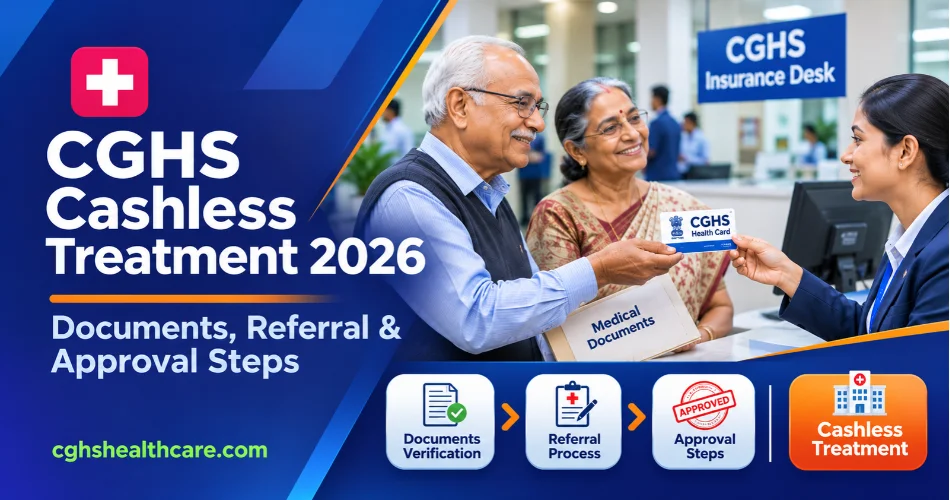
To get cashless treatment under CGHS, you need a valid CGHS card, a referral (permission) letter from your CGHS wellness centre for planned treatment, and a hospital that is empanelled for that specific procedure. The hospital checks your card and letter, treats you at CGHS-approved rates, and bills CGHS directly. You sign the acknowledgement and pay only the non-payable balance. In a genuine emergency you can go straight to a hospital without a referral.
This guide covers the steps, documents, approval rules and 2026 clarifications, so you know what to carry and what to ask before you are admitted.
Key takeaways
- Planned treatment: get a referral letter from your CGHS wellness centre or dispensary first.
- Emergencies: no prior referral is needed. You may be treated at any hospital and claim reimbursement as per package rates.
- Empanelment is procedure-specific. A hospital can only treat you for the specialities it is empanelled for.
- 2026 clarification (11 August 2026): follow-up consultations and tests up to ₹3,000 should stay at the same hospital. CT, MRI, PET and any test above ₹3,000 need a CGHS referral.
- Cashless is not guaranteed in every case. It depends on your entitlement, the referral, the hospital's empanelment and approval.
What does "cashless" mean under CGHS?
The Central Government Health Scheme (CGHS) is run by the Ministry of Health and Family Welfare for central government employees, pensioners and their eligible dependents. "Cashless" means you do not pay the approved treatment cost at the hospital counter. The hospital raises the claim with CGHS at the notified package rates.
Cashless is different from reimbursement:
- Cashless: you use an empanelled hospital with the right referral, and the hospital bills CGHS.
- Reimbursement: you pay first (for example in an emergency at a non-empanelled hospital) and later claim the amount as per CGHS rates and rules.
You may still have to pay for items that CGHS does not cover (non-payable items) and for any upgrade beyond your entitled ward.
Who is eligible for cashless treatment?
You can use cashless facilities if you hold a valid CGHS card as one of the following:
- A serving central government employee in a CGHS-covered area
- A pensioner, including family pensioners
- An eligible dependent family member named on your card
In September 2026, reports said the Ministry had removed the geographical restriction for serving employees posted outside CGHS areas, who can now reportedly opt in through a one-time option. Check the latest office memorandum on the official CGHS website before relying on this, as implementation details can change.
Some beneficiary categories, such as employees of certain autonomous institutes, may need a credit or permission letter from their parent organisation. Confirm this with your office.
Step-by-step: how to get cashless treatment under CGHS
Step 1: Check that the hospital is empanelled for your treatment
Empanelment is by city and by procedure. Before you go:
- Confirm the hospital is on the current CGHS empanelment list for your city.
- Confirm it is empanelled for your specific speciality or procedure.
- Check that its empanelment validity has not lapsed.
You can search by city, category and treatment in our directory of CGHS empanelled hospitals, then cross-check against the official list on cghs.mohfw.gov.in.
Step 2: Get a referral (permission) letter for planned treatment
For non-emergency care:
- Visit your CGHS wellness centre or dispensary.
- Consult the Medical Officer (MO), who assesses your case.
- The MO issues a referral letter naming the hospital, the diagnosis and the test or procedure, with a validity period.
A referral letter should be signed, stamped and carry an issue number, and it should be specific to the treatment or investigation. Hospitals are expected to honour such letters, but they should not treat you for a specialty in which they are not empanelled.
Validity: for certain long-term treatments, CGHS permits referral letters with six-month validity for diabetes, hypertension and other cardiac diseases, dialysis and cancer. One letter can then cover repeat visits within that period, at intervals advised by the government specialist. For some procedures such as chemotherapy, radiotherapy and dialysis, permission validity of three to six months is also described. Always check the validity written on your own letter.
Step 3: Carry the Required Documents
Keep the following documents ready before visiting the hospital:
- Original CGHS Card or E-Card: Required to verify your beneficiary details.
- Photo ID: Aadhaar, PAN or pensioner ID for identity verification.
- Referral or Permission Letter: Required for planned cashless treatment.
- Previous Medical Records and Prescriptions: Help doctors understand your medical history.
- Emergency Slip or Justification: Required to support claims in emergency cases where no prior referral was obtained.
- Photocopies of CGHS Card and Referral: Hospitals generally keep copies for their claim records.
Under the 2024 Standard Operating Procedure (SOP), hospitals should not insist on the original referral memo, and a photocopy is acceptable. However, keep your original document safe.
Step 4: Hospital verification and pre-authorisation
At admission, the hospital verifies your card and referral. For planned procedures, hospitals typically submit an estimate and seek approval through the CGHS online system. If the cost rises during treatment (for example, extra days or an added procedure), the hospital has to request an enhancement. The 2024 SOP mentions approval and enhancement through the National Health Authority portal, without needing separate approval from the local CGHS additional director's office.
Ask the hospital helpdesk three questions before you start:
- Is my procedure covered under the CGHS package rate?
- Has pre-approval been requested, and what is the status?
- Which items could be non-payable or an extra charge?
Step 5: Treatment, discharge and settlement
At discharge:
- The hospital settles the approved amount directly with CGHS.
- You sign an acknowledgement.
- You pay only non-payable items and any difference if you chose a higher ward than your entitlement. CGHS pays up to the rate for your entitled ward.
Keep copies of the discharge summary, itemised bill and any prescriptions.
What if it is an emergency?
You do not need a referral for a genuine emergency. CGHS beneficiaries may be treated at the nearest hospital, whether or not it is empanelled, and can claim reimbursement as per package rates.
- Go to the nearest hospital first. Do not delay care to find an empanelled one.
- Ask the treating doctor for an emergency certificate or justification.
- Keep the original bills, discharge summary, pharmacy bills and reports.
- If treated at an empanelled hospital, tell the billing desk that you are a CGHS beneficiary so it can process the case under the scheme.
The 2026 clarification on follow-ups and the ₹3,000 test rule
An office memorandum dated 11 August 2026 clarified several points that commonly caused claim problems:
- Follow-up consultations, investigations and minor procedures should be done at the same empanelled hospital where the primary consultation took place.
- If a specialist prescribes a test costing up to ₹3,000 (per test), it should be done at that same hospital.
- CT, MRI and PET scans, and any investigation costing more than ₹3,000, need a CGHS referral or endorsement.
- If you want a ₹3,000-or-below test done at a different hospital or lab, take prior referral from the wellness centre.
- The ₹3,000 figure is a threshold for where tests are done and when referral is needed. It is not a cap on reimbursement.
- Reports also say consultations are valid for 7 days within the same speciality, and that the eye consultation fee covers three examinations. Confirm these points on the official memorandum.
Practical tip: before booking any scan or test, ask the specialist for the estimated cost. If it is over ₹3,000, get the referral first.
Who may not need a fresh referral
Under the 2024 revised referral guidelines and SOP, some situations have eased requirements, for example:
- Minor procedures that do not require admission, advised by an empanelled hospital specialist, may not need a fresh referral from the CGHS Medical Officer.
- Beneficiaries aged 70 and above have a "non-referral" option for booking in the online system.
Rules differ by case and are updated through memoranda, so confirm with your wellness centre before relying on an exemption.
Common reasons cashless is refused, and what to do
- The hospital is not empanelled for that procedure. Ask for a hospital empanelled for it, or return to your wellness centre for a corrected referral.
- Referral is missing, expired or unspecific. Go back to your MO for a fresh or corrected letter.
- The empanelment has lapsed. Check the latest official list and choose another hospital.
- The card or dependent details do not match. Resolve this at the wellness centre.
- The hospital says it does not offer cashless for this case. Ask in writing, contact the CGHS additional director's office for your city, and use the grievance channels on the official CGHS website. If you pay, keep every original bill for reimbursement.
Practical checklist before you go
- Hospital is empanelled for the exact procedure and the empanelment is valid
- Referral letter is signed, stamped, numbered and still valid
- Original CGHS card, photo ID and photocopies in hand
- Past records and prescriptions packed
- Estimate and approval status confirmed with the hospital
- Ward entitlement and non-payable items clarified
- Hospital contact and CGHS helpline details saved
Starting your search? Browse CGHS hospitals in Delhi, cancer treatment centres, heart care hospitals or eye centres.
Frequently asked questions
Is treatment under CGHS always cashless?
No. It is cashless when you use a hospital empanelled for your procedure with a valid referral, subject to entitlement and approval. In emergencies at non-empanelled hospitals you usually pay first and claim reimbursement.
Do I need a referral for every visit?
For planned treatment, yes, unless an exemption applies. Some long-term treatments allow a referral valid for six months, and some minor procedures and follow-ups have relaxed requirements.
Can I use my CGHS card in any city?
CGHS cards have been clarified as valid in CGHS cities regardless of where the card is registered. Referral rules still apply.
What is the ₹3,000 rule in CGHS?
It is the August 2026 threshold: tests up to ₹3,000 prescribed by a specialist should be done at the same hospital as the consultation, while CT, MRI, PET and tests above ₹3,000 need a CGHS referral. It is not a reimbursement cap.
Can I go to any private hospital for emergency treatment?
Yes. In a genuine emergency you can be treated at any hospital and claim reimbursement as per package rates.
What if my hospital is not empanelled for the procedure?
The hospital should not treat you under CGHS for a specialty it is not empanelled for. Ask your wellness centre for a referral to a hospital that is.
How do I check if a hospital is on the CGHS list?
Use the official lists on cghs.mohfw.gov.in and cross-check with our hospital directory. Always confirm the empanelment validity with the hospital.